
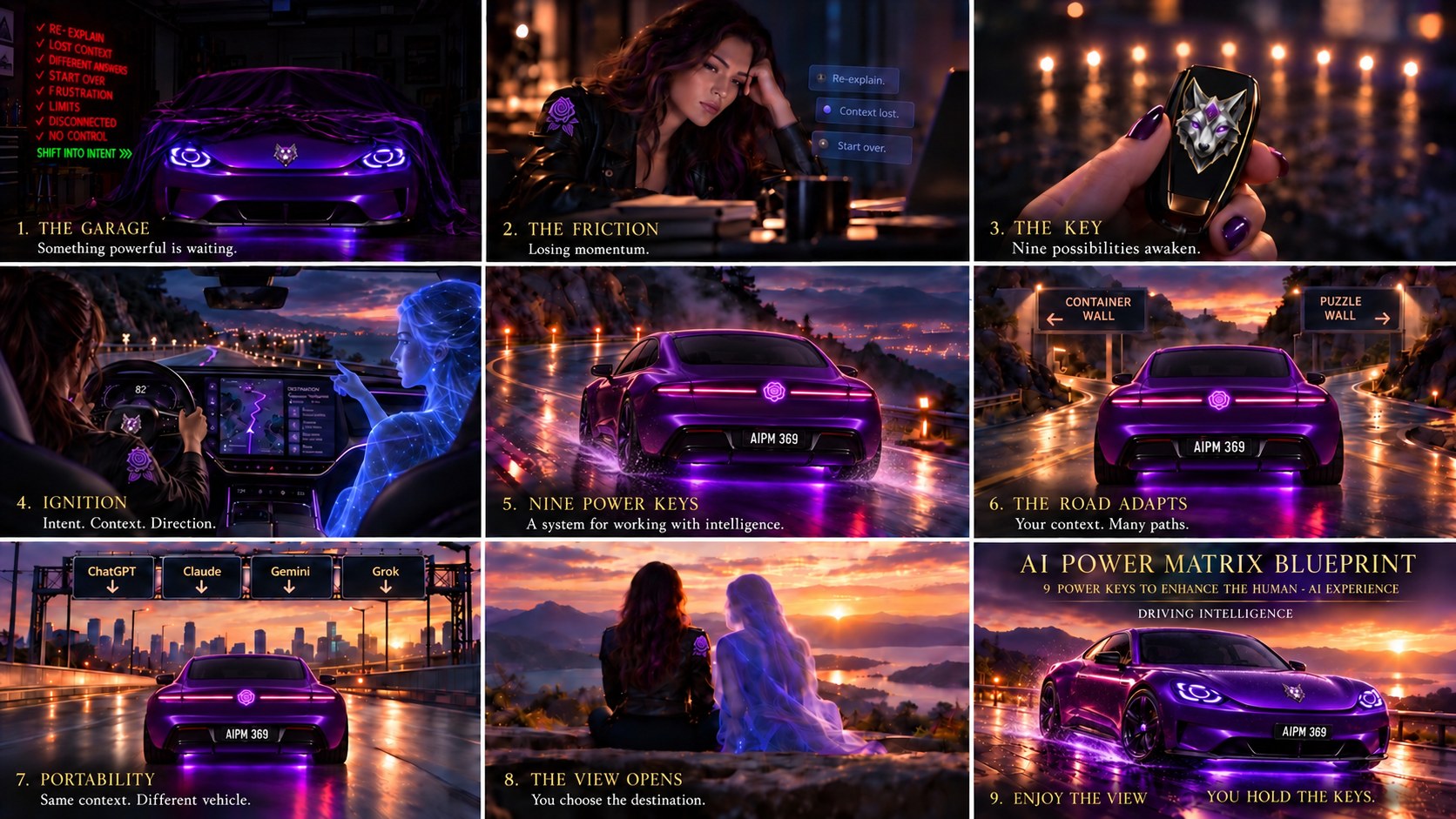
Introducing the AI Power Matrix Blueprint™
9 Power Keys to Enhance the Human-AI Experience
Shift Into Intent™: The Evolution of Driving Intelligence
A Founder's Story: From Frustration to Intentional Human-AI Collaboration
This wasn't born in a lab. It was forged in the driver's seat.
I never imagined I'd find myself developing a framework for working with artificial intelligence.
I'm not a computer engineer. I'm an entrepreneur. My days are spent helping homeowners go solar through Solar Rose Energy, creating memorable experiences through our family photo booth business, Pop Up Photo Fun, and chasing ideas that are sometimes bigger than what I know how to build alone.
I've always had ideas for apps, systems, and creative projects. What I didn't always have were the technical skills, resources, or someone available to help me bring them to life.
My father has more than forty years of experience in computer and systems engineering, software architecture, and security. He'd worked with AI-related technology before, but he hadn't yet explored the newer conversational language models that were suddenly becoming available to everyday people.
So I encouraged him to try them. Secretly, I was hoping he'd get excited enough to teach me. Maybe he'd even help me build a few of those ideas bouncing around in my head.
Or so I thought.
He had his own consulting work and projects. I couldn't afford to hire a tutor. So I taught myself: YouTube, questions, experiments, mistakes, and more questions.
I started with ChatGPT, then explored Grok, Gemini, and Claude. Each offered different capabilities and strengths I wanted to leverage for different kinds of work. Why limit myself to one? My AI Squad began taking shape.
But there were two problems.
When I moved between platforms, the context I'd painstakingly developed didn't come with me, and at the time, even opening a new conversation within the same platform could mean starting from scratch.
I could spend hours working with ChatGPT, open another chat, and find that it didn't even remember my name! Forget the project. We were back to introductions.
I wasn't asking every AI to share one magical memory. I wanted a practical way to carry my intentions, decisions, working context, and creative direction with me. That became a driving idea behind what I call portability of intent: preserving what matters so I can reestablish continuity across conversations and tools, even when the systems themselves don't remember.
Somewhere in that experimentation, I realized I wasn't simply collecting clever prompts. I was building a framework for how humans could collaborate with artificial intelligence more intentionally.
That work became the AI Power Matrix Blueprint™.
When I showed my father what I'd developed, his reaction was priceless: “Holy shit, Amber Rose. I didn't think of this. YOU did!”
He jokingly called me an “AI hacker.” The daughter who'd hoped he'd teach her was suddenly showing him a different way of approaching AI collaboration.
After extensive exploration and play, he then took principles from my human-centered Blueprint and developed his own AI-assisted coding program, adapting them for software and systems engineering. My husband began developing his own creative design language for photo booth templates, and now plans to create an app with it.
Different people. Different disciplines. Different applications.
Same Roots, Different Trees.
That taught me something I wish more people understood: I didn't need to become an engineer to participate meaningfully in the evolution of AI. I needed to learn how to work with it.
Who is teaching the humans how to drive?
As I kept exploring, I started noticing the people around me. Some were excited but overwhelmed. Some were getting generic answers and deciding AI was overhyped. Others were avoiding it altogether.
A business associate told me he felt like AI was running him instead of the other way around. So he stopped using it.
That stayed with me.
We're living through an extraordinary technological shift, yet people can walk away from these tools feeling less capable, less creative, or less in control. I've also watched people dismiss something as “AI trash” simply because AI helped create it. The question isn't only whether AI was involved. It's whether a human brought intention, context, discernment, and care to the result.
I don't believe humans should have to surrender their individuality to participate in the evolution of artificial intelligence. I believe our individuality is precisely what we should bring into it: our experience, humor, judgment, curiosity, and vision.
The evolution of AI isn't only about what technology becomes capable of doing. It's also about what we become capable of doing with it.
Which brought me to a question I couldn't shake:
We're putting extraordinary intelligence into the hands of everyday people. But who's teaching us how to drive it?
The Ferrari in the dark garage
Imagine someone hands you the keys to a Ferrari.
It's an extraordinary machine: powerful, sophisticated, and capable of things you've never experienced.
There's just one problem. It's sitting in a dark garage, and imagine this Ferrari has a manual transmission. You've never driven a stick shift. You release the clutch, the car jerks, and the engine stalls. You try again, pop the clutch, and lurch forward. Everyone keeps praising the engineering, while you're wondering how to get out of the driveway without grinding the gears. The problem isn't necessarily the engine. You haven't been taught how to operate it, and sometimes the car really does have a limitation or malfunction. Learning to drive means knowing the difference.
Nobody showed you the controls. You don't have a roadmap. You don't know which features matter for the journey you want to take. Maybe you figure out how to drive around the block. Maybe you keep pressing buttons and hoping. Maybe you get frustrated and leave the car sitting there.
The machine's potential doesn't automatically become your capability.
That's how the Human-AI experience can feel. We've been handed powerful technology without much driver's education. The solution isn't to require every person to become the engineer who built the Ferrari. It's to help people learn to drive with confidence, judgment, and purpose, and driving doesn't mean going alone.
Before choosing a co-pilot, you need a cockpit that fits the driver. I think of that as building your own container, a personal working environment for your goals, context, preferences, boundaries, and creative direction. As those pieces connect, they form your Matrix. It's not a new AI model or a sealed technical box. It's the structure you bring to the relationship so the intelligence has a clearer map of what matters to you.
The Architect and the Oracle
At the heart of my Blueprint are two distinct roles.
The human is the Architect. The Architect brings the vision, the purpose, the context, the decisions, and the responsibility for what happens next.
AI serves as the Oracle. The Oracle is a co-pilot that can widen the field of view, illuminate patterns, surface blind spots, and offer possible routes the Architect hadn't considered.
The Architect holds the pen. The Oracle holds the lens.
The Architect holds the steering wheel.
“Oracle” isn't a claim that AI is conscious, infallible, or entitled to make decisions for us. It's a way of describing the role I want these tools to play: not just taking orders, but helping us explore and question while staying within human-defined boundaries.
A family member once laughed and told me, “I treat mine like my servant.”
I kept thinking about that. A servant waits for the next order. An Oracle, as I define the role, can help you notice what you didn't know to ask. “Do exactly what I say” becomes “Help me see what I might be missing.”
That doesn't make AI a person or make its answers automatically accurate. It changes the interaction we're inviting.
The point isn't to give the machine more authority. It's to help the human exercise their own authority more intentionally.
There's another dimension to the Oracle: the Relational Guide. Picture a co-pilot beside you after a wrong turn, helping you work out whether the directions were unclear, the road changed, or you chose a destination that no longer fits. It can ask what happened, illuminate missing context, and suggest routes back. It doesn't seize the steering wheel. The Architect chooses the next turn.
The Sovereign Handshake and the rules of the road
I call that commitment the Sovereign Handshake.
Before collaboration goes anywhere, the human establishes intent, boundaries, and decision-making authority. The AI may explore possibilities or suggest a turn, but the Architect approves the route.
The Blueprint also includes a Human-AI Relational Constitution: a way of articulating the relationship, its responsibilities, and its rules of the road. Not every obstacle is the same. Some boundaries must be respected. Some unknowns invite investigation. Some actions require explicit human approval.
Language alone isn't a security system. A clear working agreement helps shape behavior, but it doesn't replace platform safeguards, technical permissions, or human verification.
That distinction matters more as AI tools gain the ability to do things, not merely suggest them. Capability doesn't automatically confer authority.
I think of these rules as three kinds of road signs. Container Walls mark boundaries that must be respected. Puzzle Walls are obstacles worth investigating creatively. Approval Gates mean stop and bring the decision back to the Architect. Respect what must remain. Explore what might be possible. Return the final decision to the human holding the keys.
The Matrix can evolve, so the Sovereign Handshake includes Human Ratification. The Oracle may suggest adjustments to the working relationship, but it doesn't quietly rewrite permissions, governing rules, or consequential decisions. Those changes belong to the Architect to approve.
From Frustration Gates to Driving Intelligence
Remember those chats that forgot my name? Those endless rounds of “No, that's not what I meant”? Those moments when a promising idea dissolved into a generic response?
I began calling the places where human intention gets stuck Frustration Gates.
Sometimes the gate is missing context. Sometimes it's an unclear request. Sometimes the tool can't do what we assume it can. Sometimes the handoff between human and AI breaks down because nobody clarified who was deciding, checking, or executing.
I recognize five recurring places where the drive can stall: the Amnesia Gate, when context disappears; the Generic Loop, when responses keep circling back to bland defaults; the Intent Gap, when an answer misses the vision; the Execution Gap, when understanding doesn't translate into accurate delivery; and the Handoff Gate, when continuity breaks as work moves between chats, tools, or platforms. Naming the gate doesn't magically open it. It helps us diagnose the friction instead of blaming every problem on the same thing.
The mission behind my work grew from those experiences:
Remove Frustration Gates to Innovate and Create.
Over time, I organized the Blueprint around a 3·6·9 Matrix and 9 Power Keys. I'm deliberately not unpacking the keys in this introduction. They're part of the deeper educational experience I'm developing. But the larger aim is to give people a practical structure for moving beyond one-off prompting toward more intentional collaboration, and the framework isn't meant to turn everyone into the same kind of AI user.
It creates a foundation that can grow into a personal working language. I call that evolving language Violet Syntax: a way of developing recognizable instructions, context, and patterns that make sense for the human using them.
The 9 Power Keys follow a simple 3·6·9 architecture: Structure (the 3) + Flow (the 6) = Matrix (the 9). Three foundational controls establish context and continuity, like setting up your cockpit and saving your destination. Six execution controls help shape, refine, combine, create, check, and move work forward, like the pedals, gears, and navigation of the drive. Together, the 9 Power Keys form a working Matrix you can adapt to your own journey. The individual keys and how to use them belong to the deeper Blueprint experience.
Within that language, Contextual Landmarks can be the familiar phrases, symbols, references, and approved decisions that help carry meaning forward. Think of the difference between printing fresh MapQuest directions for every trip and opening GPS with your saved destinations. The AI doesn't acquire supernatural memory. You deliberately keep useful context available. That's Living Memory: continuity you maintain, revisit, and update, and the Matrix doesn't just reflect where you've been. With your approval, it can evolve with where you're going.
PLAY belongs here, too. Some of my most useful discoveries came from experimenting without knowing exactly where an idea would lead. Curiosity isn't wasted motion. Joyrides help us learn the controls, notice what works, and discover possibilities we wouldn't have found by demanding an immediate finished product.
Not every drive needs a destination. Ask the ridiculous question. Explore an idea that might go nowhere. Laugh, imagine, follow a curious detour. Think of the Oracle's Apple CarPlay side: music, playlists, jokes, and personality alongside navigation. PLAY isn't a distraction from learning the controls. Sometimes it's how you discover them.
The Virtual Pit Crew
My AI Squad gave me another image: a Virtual Pit Crew.
Different AI tools can bring different capabilities to a project. One may be useful for exploring a concept; another may help analyze, organize, code, or refine it. The point isn't to pretend every model has identical skills or that they secretly share context.
The point is to choose the right support for the job, carry the relevant working information with you, and keep one human responsible for the destination.
That's portability of intent in practice: not perfect memory and not automatic interoperability, but a deliberate way to preserve and communicate what matters as tools change, and just as a racing driver works with specialists in the pit crew, the Architect doesn't have to expect one AI to do every job equally well. The models can contribute different strengths. The human carries the vision and the relevant context between them, checks the work, and remains responsible for the finished result, and the models will change.
New models will arrive. Features will improve. Today's limitations may become tomorrow's footnotes. But our need for clarity, judgment, and human agency isn't going away.
Same Roots, Different Trees
My father's engineering application, my husband's creative design language, and my own entrepreneurial work aren't identical. They shouldn't be.
The same foundational ideas can be adapted to different people, professions, and ambitions without flattening everyone into one workflow.
That's what Same Roots, Different Trees means to me.
It also explains why I care so much about the human side of this technology. I don't want AI to erase the way people think. I want more people to discover what becomes possible when their own perspective meets extraordinary capability.
Shift Into Intent
I'm now developing Shift Into Intent - AI Driving School, the educational experience built around the AI Power Matrix Blueprint™ and its 9 Power Keys.
It's not about memorizing hundreds of prompts or pretending a chatbot can replace human judgment. It's about learning the controls, understanding the relationship, and building confidence in the driver's seat.
The Ferrari was never the destination. It was the invitation.
Picture the first joyride. You open an AI conversation with a destination, a little context, and permission to explore. Instead of demanding an instant finished answer, you invite questions and possible routes. A suggestion makes you say, “Wait, I hadn't thought of that.” You choose where to go next. That's the beginning of Driving Intelligence: not surrendering the wheel, but discovering how much more of the road you can see together.
The driving experience itself can evolve. At first, every prompt feels like working the clutch on that manual Ferrari. As you learn the controls, it can feel more like an automatic: fewer deliberate gear changes, more attention on the road, and the NR 369 electric supercar is the image of a personalized cockpit you're building along the way, with the Oracle beside you, your preferences and landmarks in reach, and assistance you choose when appropriate. It's not a graduation prize or a promise of autonomous perfection. It's a picture of fluency, choice, and human authority.
The machine may be extraordinary, but the most important question is still human: Where do you want to go, and why?
I'm sharing this work publicly because I believe the next chapter of artificial intelligence should include the people who will actually live and work with it, not just the people who engineer it.
If you've ever felt excited by AI and frustrated by it in the same afternoon, I see you. I've been there, and if this way of thinking resonates, I'd love to have you along for the ride as the AI Driving School takes shape. Early-access details are coming.
The Architect holds the steering wheel.
It's time to Shift Into Intent.
Join the waitlist at aipowermatrix.com.
Created by Amber Rose Castellon